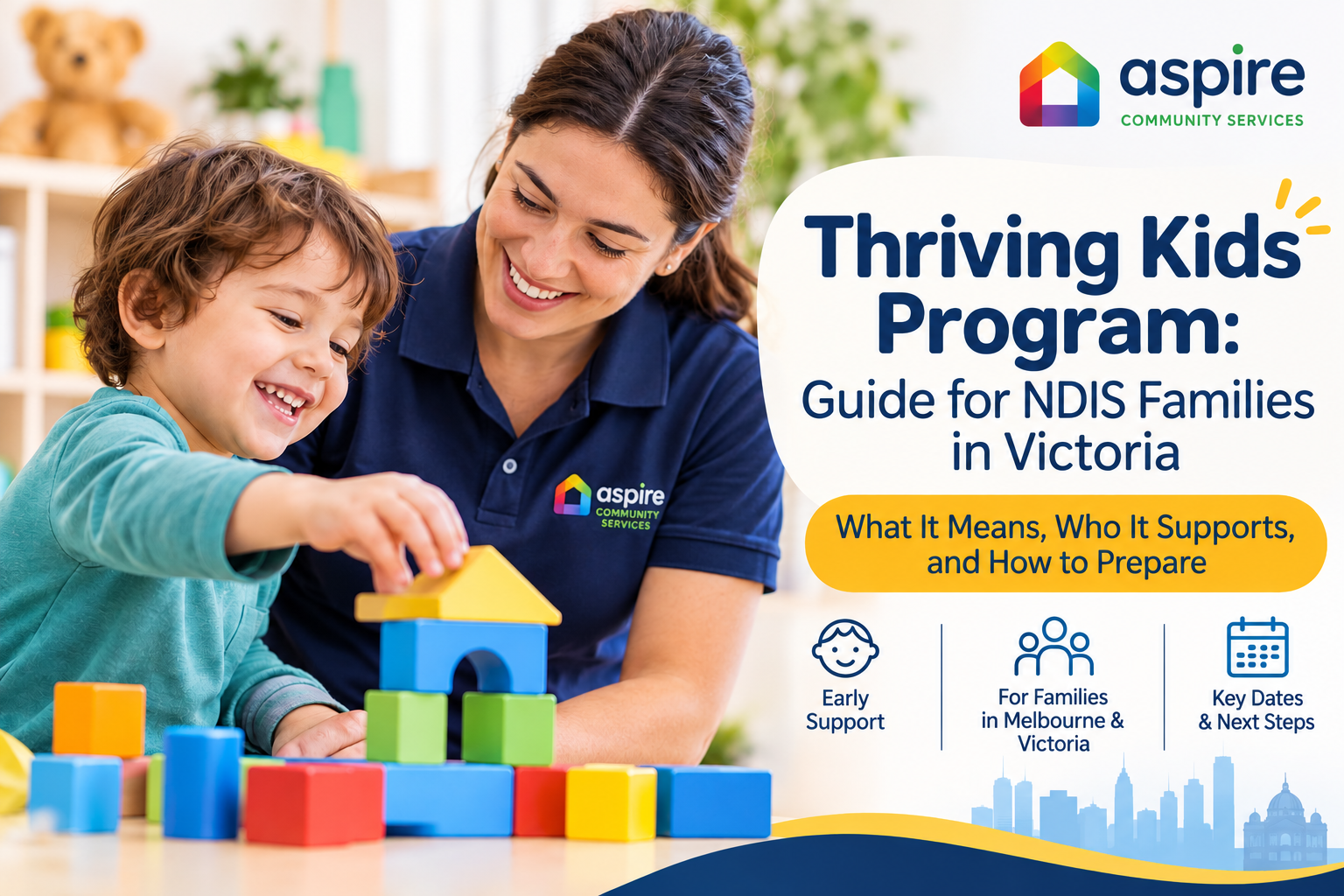
If you’re a parent or carer of a young child with a developmental delay or autism, you’ve probably come across the term “Thriving Kids” somewhere in the last few months – in a Facebook parent group, a news headline, or a conversation with your Local Area Coordinator. And if it left you with more questions than answers, you’re not alone.
Thriving Kids is one of the biggest changes to disability support for young children since the NDIS itself began. At Aspire Community Services, we work with families across Melbourne and Victoria every day, and this is now one of the most common questions we’re asked at intake calls and plan reviews. So we’ve put together a plain-English guide to what Thriving Kids actually is, who it affects, and what families should be doing right now to prepare.
Thriving Kids is a new, government-funded system of support for children aged 8 and under who have a developmental delay or autism with low to moderate support needs. It sits outside the NDIS and is being delivered through everyday settings families already use – maternal and child health services, early learning centres, and schools – rather than through an individual NDIS plan.
The program is part of a broader initiative called Foundational Supports, which the Commonwealth, state and territory governments are jointly funding. The idea is to give children access to early help sooner, without needing a formal diagnosis or a full NDIS access application first.
Thriving Kids is being rolled out in stages, starting with state-based services from 1 October 2026, with the program expected to be operating at full scale by 1 January 2028.
This is the part that causes the most anxiety, so let’s be direct about it.
Children who remain on the NDIS:
Kids aged 8 and under with a permanent and significant disability – including developmental delay or autism where there is substantially reduced functional capacity, often described as “high support needs” – continue to be eligible for the NDIS as usual. Nothing changes for this group under current arrangements.
Children who move toward Thriving Kids:
Children aged 8 and under with developmental delay or autism assessed as low to moderate support needs are the group Thriving Kids is designed for. Rather than applying for an individual NDIS plan, these children and their families will be connected to state-delivered services matched to their needs.
What about kids already on a plan?
Children already receiving NDIS support before the access changes take effect will be reassessed using the eligibility rules that were in place at the time, rather than having new criteria applied retrospectively. Broader changes to NDIS access arrangements for this age group are expected to commence from 1 January 2028, giving families a transition window rather than an overnight cut-off.
It’s worth repeating what the government has stated clearly: no child is meant to lose access to essential support during this transition. The intention behind Thriving Kids is to widen the front door to early support, not narrow it – but we understand why the uncertainty around “which category will my child fall into” is stressful for families right now.
Two things are driving Thriving Kids. First, the number of young children entering the NDIS with developmental delay or autism has grown quickly, and many of these children have needs that early, community-based support could address without the complexity of an individual funded plan. Second, the government has flagged an ambition to moderate the overall growth rate of the NDIS, and shifting lower-needs early childhood support into a separate, mainstream-integrated system is one part of that broader strategy.
For families, the practical upside is speed and simplicity: support through your child’s existing early learning service or school, without waiting on an NDIS access decision.
Change like this is easier to navigate with the right people around you. Our team supports NDIS families across Melbourne and Victoria with children’s respite services, skills development, and support coordination that helps you make sense of exactly these kinds of policy shifts – in plain language, without the jargon. If you’re unsure how Thriving Kids might affect your child’s current or future support, get in touch with our team and we’ll talk it through with you.
FAQ
Will my child lose their NDIS funding because of Thriving Kids?
Not automatically. Children with permanent and significant disability, including high support needs related to developmental delay or autism, continue to be eligible for the NDIS. Thriving Kids is designed for children with low to moderate needs who aren’t yet in this higher-needs category.
When does Thriving Kids actually start in Victoria?
State-based Thriving Kids services begin rolling out from 1 October 2026, with the program expected to reach full scale nationally by 1 January 2028.
Does my child need a formal autism or developmental delay diagnosis to access Thriving Kids?
One of the stated goals of Thriving Kids is to make early support accessible without requiring families to wait for a formal diagnosis first, since support is intended to be delivered through everyday settings like early learning and maternal and child health services.
What happens to children already on an NDIS plan when the new access rules start?
Children already enrolled in the NDIS before the access changes commence on 1 January 2028 will be reassessed using the eligibility criteria that applied before that date, rather than the new criteria.
Is Thriving Kids only for children with autism?
No. It covers children aged 8 and under with developmental delay and/or autism who have low to moderate support needs — it isn’t limited to one diagnosis.